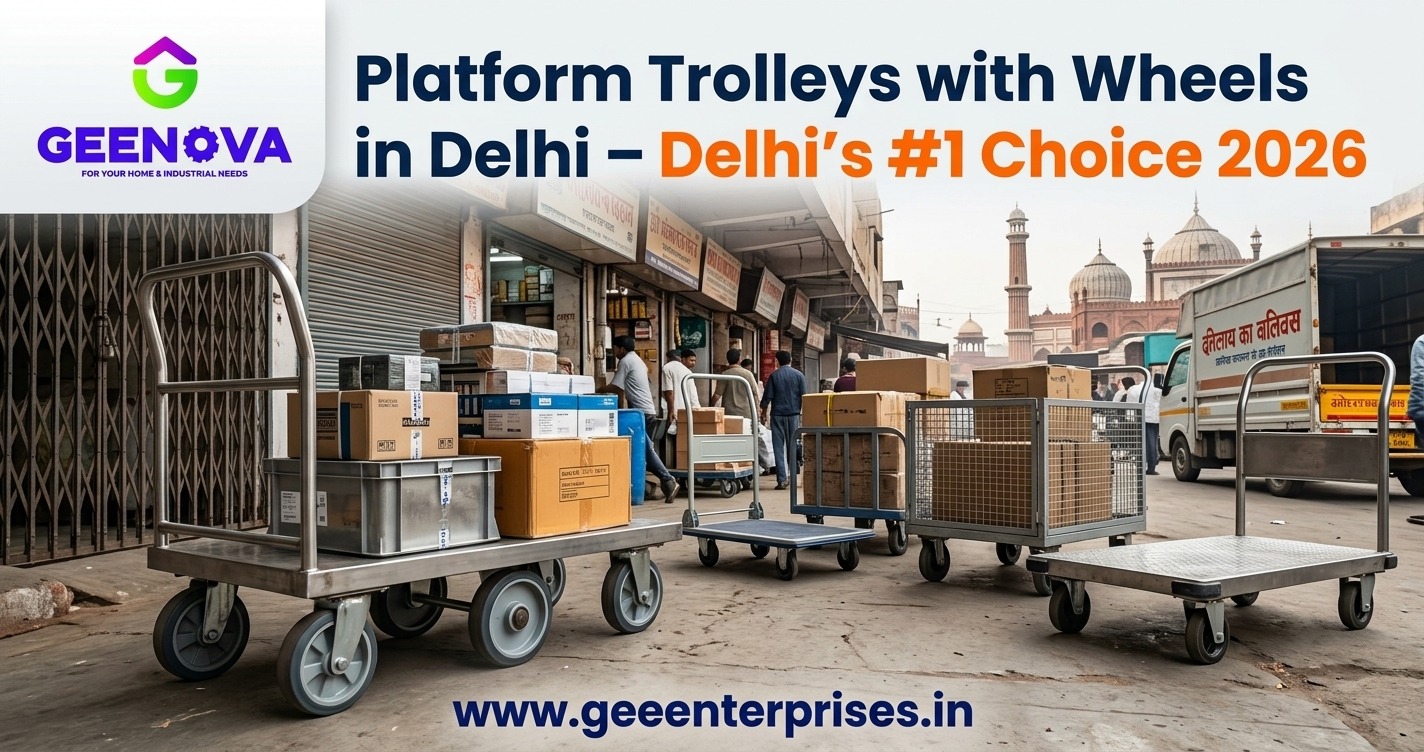
Moving heavy loads across a warehouse floor, a busy retail store, or a crowded market lane in Delhi is never simple. Boxes pile up, staff get tired, and productivity slows down. This is exactly where a platform trolley with wheels in Delhi becomes an everyday essential rather than a luxury. Whether you run a small shop in Sadar Bazar, manage a warehouse in Narela, or operate a logistics unit in Bawana, the right trolley can cut manual labour, reduce workplace injuries, and speed up daily operations.
This guide walks you through everything you need to know before buying a platform trolley in Delhi in 2026 the types available, load capacities, materials, wheel technology, industry applications, and the practical factors that separate a trolley that lasts ten years from one that breaks down in ten months. Throughout this article, real buying considerations from Delhi's material-handling market are covered, along with how a long-established local name, Gee Enterprises, fits into this picture.
A platform trolley is a wheeled equipment unit built around a flat, load-bearing surface mounted on castor wheels. Unlike a simple hand cart, a platform trolley is engineered specifically to carry bulky, heavy, or irregularly shaped goods across short and medium distances inside a factory, across a warehouse floor, through a retail backroom, or along a loading dock.
In a city like Delhi, where commercial spaces range from tightly packed wholesale markets to sprawling industrial units in areas like Narela, Bawana, and Mundka, the demand for dependable material-handling equipment has grown steadily. Manual lifting of heavy cartons, machinery parts, or bulk inventory not only slows down work but also raises the risk of injury to workers. A well-built platform trolley solves both problems at once: it moves more weight, faster, with less physical strain.
Every platform trolley, regardless of brand or size, is built around three functional parts:
Understanding these three components helps buyers evaluate quality before purchase, rather than choosing based on price alone.
Delhi's material-handling market offers a wide variety of trolley designs, each suited to different work environments. Choosing the right type depends on load weight, available storage space, and how frequently the trolley will be used.
|
Trolley Type |
Best Suited For |
Typical Load Range |
Key Feature |
|
Foldable Platform Trolley |
Retail stores, small offices, home use |
100-300 kg |
Collapsible design for compact storage |
|
Heavy-Duty Mild Steel Trolley |
Warehouses, factories, industrial units |
300-1000 kg |
High strength, rugged build |
|
Stainless Steel Platform Trolley |
Food industry, pharma, hygiene-sensitive units |
150-500 kg |
Rust-resistant, easy to sanitise |
|
Multi-Tier Platform Trolley |
Storage rooms, e-commerce fulfilment centres |
100-400 kg per tier |
Additional racks for segregated goods |
|
Airport/Luggage Platform Trolley |
Hotels, airports, transport hubs |
50-150 kg |
Lightweight, smooth manoeuvrability |
Each of these trolley types is manufactured and supplied across Delhi's industrial belt, and choosing between them largely comes down to matching the trolley's build to the actual working conditions it will face daily.
Most first-time buyers focus entirely on the platform's load capacity and overlook the wheels yet the wheels determine how smoothly, safely, and quietly the trolley performs over years of use. In Delhi's mixed flooring conditions from smooth warehouse epoxy floors to uneven market lanes wheel selection is critical.
|
Wheel Material |
Surface Suitability |
Noise Level |
Durability |
|
Rubber Wheels |
Smooth indoor floors, offices |
Low |
Moderate |
|
Nylon Wheels |
Warehouses, factory floors |
Moderate |
High |
|
Polyurethane (PU) Wheels |
Mixed indoor-outdoor surfaces |
Low |
Very High |
|
Cast Iron Wheels |
Heavy industrial floors, rough surfaces |
High |
Extremely High |
|
Airless PP Wheels |
Light-duty foldable trolleys |
Low |
Moderate |
A trolley with mismatched wheels, for instance, rubber wheels used on rough concrete will wear out faster and put unnecessary strain on the platform's frame. This is one of the most overlooked factors when businesses in Delhi shop for trolleys purely based on upfront cost.
Overloading a trolley beyond its rated capacity is one of the leading causes of frame damage, wheel failure, and workplace accidents. Before purchasing, businesses should calculate their average and peak load requirements realistically, rather than estimating.
|
Business Type |
Recommended Load Capacity |
Typical Trolley Size |
|
Small retail shop / boutique |
100–150 kg |
2ft x 2ft |
|
Wholesale market stall (Sadar Bazar type) |
150–300 kg |
3ft x 2ft |
|
Warehouse / godown operations |
300–600 kg |
3ft x 4ft |
|
Manufacturing / industrial unit |
500–1000 kg |
4ft x 3ft or larger |
|
Hotel / hospitality luggage handling |
50–150 kg |
Compact multi-wheel design |
It is generally advisable to select a trolley rated slightly above your maximum expected load, since consistent overloading even by a small margin shortens the working life of both the platform and the wheels significantly.
The base material of a platform trolley affects its strength, weight, resistance to rust, and overall lifespan. Delhi's humid monsoon months and dusty industrial environments make this an especially important consideration.
Mild Steel Trolleys remain the most widely used option across Delhi's industrial and wholesale markets. They offer an excellent strength-to-cost ratio and are well suited to heavy, repetitive use in warehouses and factories. The main drawback is a tendency to rust if not powder-coated or maintained properly, particularly during humid seasons.
Stainless Steel Trolleys are preferred in environments where hygiene and corrosion resistance matter such as food processing units, pharmaceutical storage, and hospitality settings. They cost more upfront but require far less maintenance over time and hold up well against moisture.
Polypropylene (PP) Trolleys are lightweight, rust-proof, and commonly used in foldable trolley designs for smaller loads. They are ideal for retail environments, home use, and situations where the trolley needs to be stored compactly when not in use, though they are not suited for extremely heavy industrial loads.
Before finalising a purchase, it helps to run through a practical checklist rather than relying on appearance or price alone.
Delhi's economy spans wholesale trading, manufacturing, e-commerce logistics, hospitality, and healthcare and platform trolleys play a role in nearly every one of these sectors.
|
Industry |
Common Use Case |
|
Wholesale & Retail Markets |
Moving stock between storage and display areas |
|
Warehousing & Logistics |
Transporting cartons, pallets, and packed goods |
|
Manufacturing Units |
Shifting raw materials and semi-finished products between stations |
|
Hospitality (Hotels) |
Moving guest luggage and housekeeping supplies |
|
Healthcare Facilities |
Transporting medical supplies and equipment within hygiene-controlled trolleys |
|
E-commerce Fulfilment Centres |
Sorting and moving packed orders during dispatch |
This breadth of application is precisely why demand for reliable, well-manufactured platform trolleys with wheels continues to grow steadily across Delhi's commercial and industrial zones.
A platform trolley is a long-term investment, and simple maintenance habits can significantly extend its usable life:
Following these steps can extend a well-built trolley's working life well beyond what buyers typically expect from budget alternatives.
Among the many suppliers operating in Delhi's material-handling equipment market, Gee Enterprises stands out for a simple reason: consistency built over decades. Since its inception in 1976, Gee Enterprises has been serving Delhi's wholesale, industrial, and retail businesses from its base in Sadar Bazar, one of the city's oldest and busiest trading hubs.
Operating for close to five decades gives Gee Enterprises a depth of practical, on-ground experience that few newer suppliers can match. This experience shows up in the details that matter most to buyers: sturdier weld joints, correctly matched wheel types for different flooring conditions, and platform trolleys built to genuinely hold their rated load capacity rather than just advertise it.
Businesses across Delhi from small shopkeepers to large warehouse operators continue to choose Gee Enterprises for platform trolleys with wheels because the company understands the real, everyday demands of Delhi's trading and industrial environment. This is not equipment designed in isolation from the market; it is built by a supplier that has operated within that same market since 1976.
|
Detail |
Information |
|
Established |
1976 |
|
Head Office Address |
3443, Gali Lallu Missar, Opp. Car Parking Gate No. 3, Sadar Bazar, Delhi – 110006 |
|
Phone |
08048951561 |
|
|
Kapil@geeenterprises.in |
|
Specialisation |
Platform Trolleys with Wheels & Material Handling Equipment |
For businesses across Delhi NCR looking for a platform trolley with wheels that is built to handle real working conditions not just showroom demonstrations Gee Enterprises remains a dependable, long-standing choice backed by decades of manufacturing and supply experience.
Delhi's commercial landscape has expanded rapidly over the past decade, with warehousing hubs spreading across Narela, Bawana, Mundka, and the outer ring of the National Capital Region. At the same time, e-commerce fulfilment centres, third-party logistics providers, and organised retail chains have multiplied their storage and dispatch operations across the city. This growth has directly increased the demand for dependable material-handling equipment, including platform trolleys with wheels.
Traditional wholesale markets such as Sadar Bazar, Chandni Chowk, and Khari Baoli continue to rely heavily on manual and semi-manual material movement, where narrow lanes and dense foot traffic make compact, manoeuvrable trolleys especially valuable. Meanwhile, larger industrial units on Delhi's outskirts require heavier-duty trolleys capable of handling bulk raw materials and finished goods. This dual demand of compact trolleys for congested urban markets and heavy-duty trolleys for expansive industrial floors has shaped the range of products available from Delhi-based suppliers today.
As labour costs rise and workplace safety regulations receive greater attention, more businesses are shifting away from purely manual lifting toward wheeled material-handling solutions. A single platform trolley, used consistently, can reduce the physical strain equivalent to multiple hours of manual carrying each day, which in turn lowers fatigue-related errors and improves overall workplace efficiency.
Selecting the right product is only half the decision, choosing the right supplier matters just as much, particularly for businesses that will need repeat purchases, replacement parts, or custom specifications over time. A few practical points can help guide this decision.
Experience and Track Record Suppliers who have operated in Delhi's material-handling market for many years tend to have a better understanding of local working conditions, common failure points, and the specific needs of different industries. A long operating history is often a reliable indicator of consistent product quality and customer trust.
Ability to Customise Not every business has identical requirements. A good supplier should be able to adjust platform size, wheel type, and load rating based on the buyer's specific operational needs, rather than offering only a fixed catalogue of standard sizes.
After-Sales Support Wheels wear out, handles loosen, and welds occasionally need reinforcement after years of heavy use. A supplier based locally in Delhi, with accessible contact details and a physical office, makes it far easier to source replacement parts or repairs quickly compared to distant or purely online-only sellers.
Transparency in Specifications Reliable suppliers clearly communicate load capacity, material type, and wheel specifications upfront, allowing buyers to make an informed decision rather than discovering limitations after purchase.
Given these factors, established, locally rooted suppliers such as Gee Enterprises — with decades of continuous operation in Delhi's Sadar Bazar trading hub — tend to offer a more dependable buying experience than newer or less established sellers.
It's worth understanding how platform trolleys compare to other common material-handling tools, since businesses sometimes need to choose between multiple options depending on their specific use case.
|
Equipment |
Best For |
Limitation |
|
Platform Trolley |
Flat, boxed, or irregularly shaped heavy goods |
Not ideal for extremely tall or unstable loads |
|
Hand Truck / Dolly |
Stacked boxes, appliances, single large items |
Lower overall load capacity |
|
Pallet Jack |
Palletised bulk goods in warehouses |
Requires flat, even flooring |
|
Wheelbarrow |
Loose materials like sand, debris |
Not suited for boxed or packaged goods |
|
Multi-Tier Trolley Cart |
Segregated smaller items, retail stock |
Lower per-tier weight limit |
This comparison highlights why platform trolleys remain one of the most versatile choices for general-purpose material movement; they handle a wider variety of load shapes and sizes than most alternatives, while remaining simple to operate without specialised training.
1.What load capacity should I choose for a small retail shop in Delhi?
For most small retail or wholesale shop setups, a trolley rated between 100-150 kg is generally sufficient for daily stock movement, though shops handling bulkier inventory may prefer a slightly higher capacity for added safety margin.
2.Are foldable platform trolleys strong enough for daily commercial use?
Foldable trolleys work well for light-to-moderate daily use, particularly in retail or office settings, but heavy industrial or warehouse operations typically require a fixed-frame, heavy-duty design instead.
3.How often should trolley wheels be replaced?
This depends heavily on usage frequency and flooring type, but well-maintained wheels on a quality trolley can typically last several years before needing replacement, especially with regular cleaning and lubrication.
4.Is stainless steel necessary for every business, or only specific industries?
Stainless steel is mainly recommended for hygiene-sensitive industries like food handling, pharmaceuticals, or hospitality; for general warehouse and industrial use, mild steel remains a cost-effective and durable choice.
5.Can platform trolleys be customised for specific load sizes?
Yes, many suppliers in Delhi, including established manufacturers like Gee Enterprises, offer trolleys built or adjusted according to a business's specific platform size and load-capacity requirements.
Platform trolleys with wheels have become an integral part of daily operations for Delhi's retail shops, warehouses, factories, and hospitality businesses. Choosing the right one depends on understanding load capacity requirements, wheel material suited to your flooring, the base material of the trolley frame, and realistic maintenance habits. Foldable trolleys suit lighter, space-conscious needs, while heavy-duty mild steel or stainless steel designs are better suited to industrial and hygiene-sensitive environments respectively. Across Delhi's material-handling market, Gee Enterprises, operating since 1976 from Sadar Bazar, continues to be a trusted supplier for businesses seeking durable, well-built platform trolleys with wheels.
A platform trolley with wheels is far more than a simple piece of equipment — it is a daily productivity tool that reduces manual strain, speeds up operations, and protects workers from avoidable injury. For businesses across Delhi, from small traders in Sadar Bazar to large-scale warehouse operators in Narela and Bawana, investing in a well-built, correctly specified trolley pays off through years of reliable service. With nearly five decades of experience in the trade, Gee Enterprises offers Delhi businesses a dependable, well-established option built specifically for the demands of the local market.
Have questions about choosing the right platform trolley for your business, or want to get in touch with Gee Enterprises directly? Reach out via phone at 08048951561 or email at Kapil@geeenterprises.in, or visit the head office at 3443, Gali Lallu Missar, Opp. Car Parking Gate No. 3, Sadar Bazar, Delhi – 110006.
About the Writer
Kapil This article has been written and reviewed by Kapil, drawing on firsthand knowledge of Delhi's material-handling equipment market and long-standing industry experience with platform trolleys and related products.

png.png)